A Historic Decline in the Cost of Cognitive Capability
First Published: MIXED MARKET ARTIST by William Lee
Throughout modern economic history, periods of transformational growth have often been preceded by a dramatic decline in the cost of a foundational resource.
The Industrial Revolution was enabled by cheaper mechanical power. The digital revolution accelerated as the cost of computing and data storage collapsed. The internet era emerged as communication and information distribution approached near-zero marginal cost.
Artificial intelligence appears to be following a similar trajectory.
Since the introduction of frontier large language models in 2023, the cost of accessing advanced AI capabilities has declined at one of the fastest rates observed in the history of technology. Models that initially cost tens of dollars per million tokens can now perform many comparable tasks for a fraction of a dollar.
The world is witnessing the beginning of a new economic phenomenon: the rapid deflation of intelligence.
The Data: A Multi-Hundred-Fold Decline in AI Costs
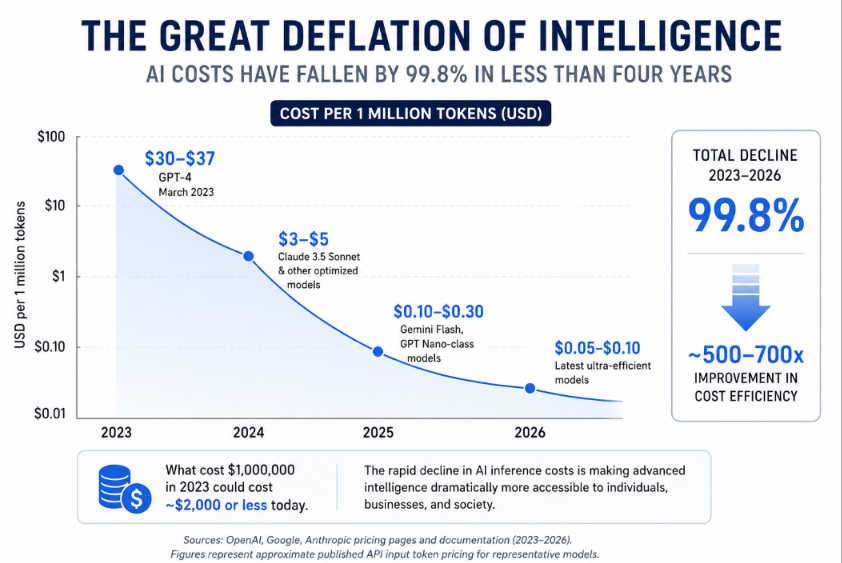
When GPT-4 was introduced in March 2023, accessing the model cost approximately $30–$37 per million input tokens, depending on the pricing structure.
By 2025 and 2026, highly optimized models became available at approximately $0.05–$0.10 per million tokens.
This represents a decline of approximately 99.7% to 99.8% in less than four years.
| Period | Representative Model | Approximate Cost per 1M Tokens | Change from GPT-4 (2023) |
|---|---|---|---|
| March 2023 | GPT-4 | $30–$37 | Baseline |
| 2024 | Claude 3.5 Sonnet and other optimized models | $3–$5 | 85%–90% lower |
| 2025 | Gemini Flash, GPT Nano-class models | $0.10–$0.30 | 99%+ lower |
| 2026 | Latest ultra-efficient models | $0.05–$0.10 | ~99.8% lower |
The Great Deflation of AI Costs

The curve above illustrates one of the most remarkable cost collapses in modern technology. In just a few years, the price of accessing advanced AI capability has fallen from approximately $35 per million tokens to roughly $0.07, a decline of nearly 99.8%.
For perspective, a company that spent $1 million on AI inference at 2023 pricing could theoretically purchase a similar volume of AI processing for approximately $2,000 or less using today’s lowest-cost
Why This is Important
This is the equivalent of a 500x reduction in the cost of intelligence. Historically, the most important economic revolutions have occurred not merely because a technology was invented, but because it became inexpensive enough to be deployed everywhere. Cheap electricity enabled mass manufacturing. Cheap computing enabled software and the internet. Cheap AI may enable a new era of widespread cognitive automation and productivity growth.
Sources and References
- OpenAI API Pricing Historical and current pricing for GPT models, including GPT-4, GPT-4 Turbo, GPT-4o, and GPT-5 model families. https://openai.com/api/pricing/
- Google AI API Pricing Pricing information for Gemini model families, including Gemini Flash and ultra-efficient inference models. https://ai.google.dev/gemini-api/docs/pricing
- Anthropic API Pricing Pricing data for Claude model families, including Claude 3.5 Sonnet and subsequent optimized models. https://www.anthropic.com/pricing
- Stanford University Human-Centered AI (HAI) – AI Index Report Annual report tracking AI capabilities, economics, training costs, inference costs, adoption, and global AI trends. https://hai.stanford.edu/ai-index
- Epoch AI – Trends in Machine Learning and AI Economics Research on AI compute trends, efficiency improvements, model costs, and the economics of artificial intelligence. https://epoch.ai/
- Our World in Data – Technological Progress and Computing Trends Long-term analysis of technological cost declines, computing progress, and historical productivity transformations. https://ourworldindata.org/
- NVIDIA – AI Infrastructure and Accelerated Computing Research Information on advances in GPU efficiency, AI inference optimization, and the declining cost of AI computation. https://www.nvidia.com/en-us/ai/
- McKinsey Global Institute – The Economic Potential of Generative AI Research estimating the productivity impact and economic value created by widespread adoption of generative AI. https://www.mckinsey.com/mgi/our-research/the-economic-potential-of-generative-ai-the-next-productivity-frontier
- Goldman Sachs Research – Generative AI and the Future of Economic Growth Analysis of AI-driven productivity improvements, labor impacts, and potential effects on global GDP. https://www.goldmansachs.com/insights/articles/generative-ai-could-raise-global-gdp
- The Economist – The Falling Cost of Artificial Intelligence Coverage of how declining model costs and increasing competition are reshaping the AI industry. https://www.economist.com/
Cost figures in this article represent approximate public API pricing for representative frontier and optimized AI models at various points in time. Actual costs vary based on model type, provider, token direction (input vs. output), and usage volume.
Ready to Build Your Company in 90 Days?
If you’re ready for structure, clarity, and forward momentum, the journey starts now.