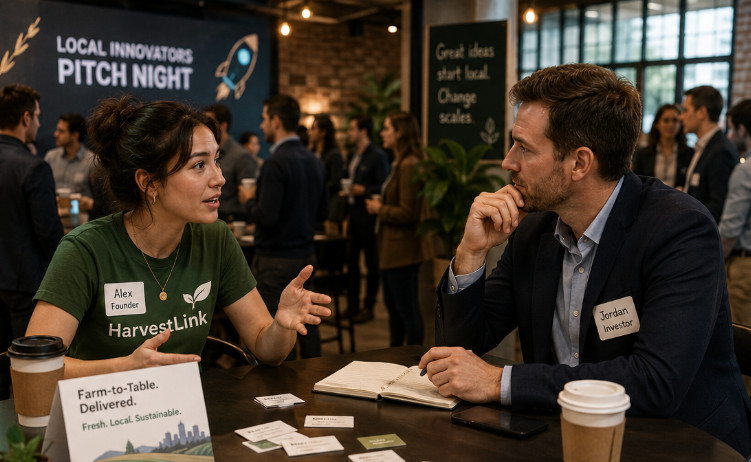
Scene: A local pitch event. The room is buzzing. Coffee cups, business cards, and hopeful energy fill the air.
Characters:
- Alex – Startup founder, launching a new platform for local farm-to-table grocery delivery.
- Jordan – Experienced angel investor, with a background in tech and logistics.
Dialogue
Jordan (Investor): So Alex, in one sentence, what problem are you solving?
Alex (Entrepreneur): We’re helping local farmers connect directly with urban consumers who want fresh, traceable food—but don’t have access to farmers markets during the week.
Jordan: That’s clear. Who’s your customer, exactly?
Alex: Our target market is working professionals ages 25–45 who value sustainability but don’t have time to shop in person.
Jordan: Got it. How big is that market? Can you quantify it?
Alex: We estimate around 12 million potential customers in the Midwest region, based on USDA data and consumer spending trends on local produce.
Jordan: And your business model—how do you make money?
Alex: We take a 15% commission on each sale made through the platform. Farmers set their own prices, and we handle logistics and payments.
Jordan: Sounds good in theory. But logistics can eat margins fast. How are you managing delivery costs?
Alex: We’ve partnered with a regional courier network, which allows batch deliveries at off-peak hours. That keeps costs 30% lower than standard last-mile delivery services.
Jordan: Smart. What’s your traction so far?
Alex: We piloted in two cities, hit 1,200 active users in three months, and retained 68% of them after their first order.
Jordan: Those are promising numbers. What’s your plan for scaling?
Alex: We’re focusing on one new metro area per quarter, using local ambassadors to onboard farmers and early adopters.
Jordan: Okay, and what’s your biggest challenge right now?
Alex: Balancing tech development with operations. We’re lean, and our logistics software needs to evolve as we scale.
Jordan: That’s honest. What kind of funding are you seeking?
Alex: $500,000 in seed funding to expand into three new markets and refine our app for automated order batching.
Jordan: And what will that get me as an investor?
Alex: A 15% equity stake, with a projected 5x return within five years if we reach our target expansion plan.
Jordan: Alright, Alex—you’ve done your homework. My last question: why you? Why are you the right person to make this succeed?
Alex: I grew up on a small farm, studied supply chain management, and I’ve seen firsthand how tech can keep local agriculture alive. This isn’t just a business for me—it’s a bridge between two worlds I know well.
Jordan: That’s the passion I look for. Let’s schedule a follow-up to go deeper into your numbers.
What Entrepreneurs Can Learn
- Investors look for clarity, not hype. Your first sentence should define the problem and audience.
- Know your numbers. Market size, margins, and retention rates show credibility.
- Be realistic about challenges. Honesty builds trust faster than overconfidence.
- Show founder-market fit. Investors invest in people as much as in ideas.
- Focus on scalability. Investors want to know how $1 today becomes $10 tomorrow.
Takeaway
Before you pitch, run through a dialogue like this out loud—or better yet, with a mentor who can challenge you. If you can answer these questions clearly, confidently, and concisely, you’re already halfway to earning an investor’s confidence.